RIVET BODY
Aluminium Rivets – Lightweight with good corrosion resistance.
Steel Rivets – Stronger than Aluminium with a “flash” coating of Zinc. Low corrosion resistance.
Stainless Steel Rivets A2 – Good Strength and excellent corrosion resistance.
Stainless Steel A4 Rivets – Good Strength and increased corrosion resistance
Copper Rivets – Relatively soft. Excellent corrosion resistance and conductivity.
Monel Rivets – The strongest blind rivet material with excellent corrosion resistance and conductivity. Also excellent high temperature suitability.
CSK HEAD BLIND RIVETS
The Countersunk or CSK head profile provides a neat and flush finish to the joint.
This enables multiple layered assembly and also a safe surface without any projection.
The countersink angle of 120° ensures that this rivet is suitable for thin sheets as well.
Available in many material combinations.
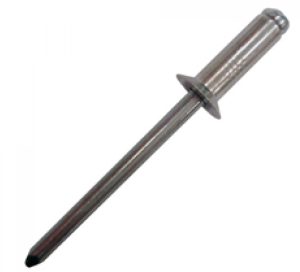
Aluminium – Steel
Blind Rivet CSK Head AL-ST E1D32G
Aluminium – Stainless Steel
Blind Rivet CSK Head AL-SS E8D32G
Steel – Steel
Blind Rivet CSK Head ST-ST A2D32G
Stainless Steel – Stainless Steel
Blind Rivet CSK Head A2-A2 B4D32S
MATERIAL USAGE GUIDE
Galvanic Corrosion • When dissimilar metals come into contact in the presence of an electrolyte, a galvanic action occurs which corrodes one metal at a faster rate and the other more slowly. This phenomenon can cause major riveted joint failures and care must be taken to avoid the occurrence. The following table is a guide.
| METAL JOINED | |||||
| RIVET MATERIAL↓ | Aluminium | Coated Steel | Stainless Steel | Copper | Brass |
| Aluminium Rivets | YES | CARE | NO | NO | NO |
| Coated Steel Rivets | NO | YES | NO | NO | NO |
| Stainless Steel Rivets | CARE | CARE | YES | YES | YES |
| Copper Rivets | NO | NO | YES | YES | YES |
| Monel Rivets | NO | NO | YES | YES | YES |
| YES | Compatible | ||||
| NO | Incompatible – Avoid contact with each other | ||||
| CARE | Use with care. Painting metals will help | ||||
Hence,
1) Select materials that are as close together as possible in the Galvanic Series Chart.
2) Provide a barrier between the two metals, such as paint, non-metallic washer or gaskets.
3) Design the fastener as the cathode so the cathodic area is small as compared to the anodic area.
4) Use a metallic finish on the fastener that is close on the chart to the mating material.